Showing posts with label large blocks of text. Show all posts

Wednesday, April 17, 2013

Typeface Review: "Bodoni"

What It Looks Like:
Picture found here.
It's History: "Bodoni is a modern serif typeface, with high contrast between thin and thick stroke weights, and a slightly condensed shape. It was based on the work of John Baskerville, but has taken his ideas to a more extreme conclusion. There are a few variations on Bodoni, some with more transitional shapes (including ITC Bodoni and Bodoni Old Face), and some more modern.

Picture found here.
"Bodoni was first designed by Giambattista Bodoni in 1798. In addition to the influence from Baskerville, Bodoni was also influenced heavily by the work of Pierre Simon Fournier and Firmin Didot." (Source #1)

What Type of Font It Is: Didone; "This category of types, also known as Modern, is based upon the typefaces produced in the late 18th and early 19th centuries in Italy by Giambattista Bodoni (1740 - 1813) and in France by Firmin Didot (1764 - 1836).

"Didones are most commonly used for display and semi-display purposes, where the accentuated contrasts of stroke width create dynamic and elegant graphic effects. While these characteristics are moderated in the smaller sizes to allow for their use in text setting, the extremes of contrast impair readability, making them a less practical choice where large amounts of copy are to be set." (Source #2)
Picture found here.
How You Can Design With It: "Bodoni, for the most part, is best suited to larger font sizes. Because of the extreme variation between thin and thick strokes, it can degrade at small sizes and become illegible (specifically, it creates an effect known as “dazzle”). There are some typeface variations though, that are optimized for use at smaller sizes (including Bodoni Old Face at 9 points, ITC Bodoni 12 at 12 points, and ITC Bodoni 7 at 7 points).

Picture found here.
"Bodoni is well-suited for use in modern designs where a serif typeface is desired. It’s a great serif for use in headlines and subheads, though some variations can be used for body copy, too. Some of its more recognizable uses can be found in the logo for grunge band Nirvana, and on the Mamma Mia! posters." (Source #1)

"Like most Didones, it can be effective in the setting of extended text, provided the printing and paper is of sufficient quality to ensure that the delicate hairlines and high contrasts are retained. All weights and widths of the Bodoni family can be used to dramatic effect as display faces." (Source #3)
Picture found here.
Where You Can Get It: You can download free versions of the font at FontSpace, UrbanFonts, CoolText, or DaFont. Or you can purchase the font at either MyFonts. There is also a newer version created by Heinrich Jost in 1926 called "Bauer Bodoni", which is slightly cheaper to purchase on websites, MyFonts and Linotype. (Source #3)

Descriptive Terms for It: Classic, Didone, display, large blocks of text, logo, logo design, logos, modern, old, and serif.

Sources:
- #1 - http://www.webdesignerdepot.com/2011/08/the-most-popular-fonts-used-by-designers/
- #2 - The Complete Typographer: A Manual for Designing with Type" by Will Hill, 2nd Edition, p. 94
- #3 - The Complete Typographer: A Manual for Designing with Type" by Will Hill, 2nd Edition, p. 96

Examples:
Picture found here.
Picture found here.
Picture found here.
Picture found here.


Picture found here.
Picture found here.
Picture found here.
Picture found here.
Picture found here.
Picture found here.
Picture found here.

Sunday, April 7, 2013

Typeface Review: "Warnock"

What It Looks Like:
Picture found here.
Picture found here.
It's History: Designed by Robert Slimbach and published in 2000 by Adobe. As part of the Adobe Originals type composition family, it was named after John Warnock, "the co-founder of Adobe Systems, whose visionary spirit has led to major advances in desktop publishing and graphic arts software.

"A full-featured, state-of-the-art OpenType family - with Latin, Cyrillic, and Greek character sets in a variety of weights and optical size ranges-Warnock Pro is a classic yet contemporary composition family that performs a wide variety of typographic tasks with elegance." (Source #1)
Picture found here.
What Type of Font It Is: Transitional; "Characterized by triangulated serifs and a lively angularity, Warnock is a Transitional with a suggestion of calligraphic form, particularly in the swash letters that form part of a very extended type family." (Source #2)

How You Can Design With It: "Transitionals are, as a general rule, well suited to the setting of large bodies of text, as well as revealing considerable elegance of individual form when used for display purposes.... The italic fonts of Transitional typefaces were designed as an integral part of the face rather than as independent faces, and as a consequence reveal far greater affinity of form with the roman letters, while varying quite widely in style. They are better suited to use for emphasis or differentiation within roman text than the italics of Garalde or Humanist faces." (Source #3)
Picture found here.
Where You Can Get It: You can purchase the font at Fonts.com, MyFonts, Linotype, Typedia, Veer, FontShop, and Adobe Systems Inc.  FontPalace has a free download of Warnock Pro-Bold available.

Descriptive Terms for It: Classic, display, elegant, large blocks of text, large bodies of text, serif, Transitional, and whole family.

Extra: There's even an open letter, penned by Andrei Michael Herasimchuk of Design By Fire, to JohnWarnock to make his namesake a part of the public domain, as well as other typefaces such as Adobe Caslon Pro, Adobe Jenson Pro, Franklin Gothic, Frutiger, Futura, Gill Sans, Helvetica Neue, and Univers.

Sources:
- #1 - http://www.myfonts.com/fonts/adobe/warnock/
- #2 - "The Complete Typographer: A Manual for Designing with Type" by Will Hill, 2nd Edition, p. 91
- #3 - "The Complete Typographer: A Manual for Designing with Type" by Will Hill, 2nd Edition, p. 84

Examples:
Picture found here.
Picture found here.
Picture found here.

Tuesday, March 26, 2013

Typeface Review: "Sabon"

What It Looks Like:
Picture found here.
It's History: "Sabon is an old style serif typeface designed by Jan Tschichold between 1964 and 1967. It was released jointly by Linotype, Monotype, and Stempel foundries in 1967. It’s based on typefaces designed by Claude Garamond, particularly the one printed by Konrad Berner of Frankfurt, as well as the italics by Robert Grandjon." (Source #1)

"One of the finest modern adaptations of the Garamond model, Jan Tschichold's Sabon stands as the culmination of a hugely influential typographic career in which type design developed alongside book typography and critical writing.

"It is names for the punchcutter and type founder Jakob Sabon of Lyons, who is credited with bringing the Garamond types originating with Plantin or Granjon into use in Franfurt, thus introducing the Garamond model into German printing. Sabon is, however, far more than a literal revival, since it incorporates characteristics drawn from the different sizes of the Garamonds to form one consistent and definitively 20th-century interpretation of the ideas that they embody." (Source #2)
Picture found here.
What Type of Font It Is: Garalde - "Garaldes include some of the most attractive and well-designed text faces in current use. They are highly legible but visually lively. As with most historically based faces, the adaptation of these letters for changing print technologies has had varying effects upon their integrity of form.

"All typefaces originating in hand-cut punches showed a considerable variation of form according to size, with the serifs relatively heavier and the modulation of stroke width less pronounced at smaller sizes. These considerations are crucial to the effective design or adaptation of Garalde faces, and distinguish quality recuts and original faces in the Garalde tradition." (Source #3)
Picture found here.
How You Can Design With It: "One of the distinguishing features of Sabon is that the roman, italic, and bold weights all take up the same width when typeset. It’s an unusual feature, but meant that only one set of copyfitting data is needed for all three styles.

"Sabon is a highly legible typeface, with moderate contrast between thick and thin strokes. That makes it suitable for use in a variety of sizes.

"Sabon is a favorite for typesetting book copy, and is well-suited to any traditional or formal design." (Source #1)

"It has an elegant bold font, and it is exceptionally balanced and legible across italic and roman in both its weights. It has a harmonious visual consistency and few obtrusive distinguishing features - an inclined stress, open counters, and a complementary interaction between characters. It incorporates expert set features, including small caps, ligatures, and non-lining numerals." (Source #2)
Picture found here.
Where You Can Get It: You can buy the Sabon font and the whole font family at LinoType, AdobeFonts.com, FontShop, MyFonts, or Webtype.

Descriptive Terms for It: Book copy, Garalde, Jan Tschichold, large blocks of text, large bodies of text, legible, Old Style Serif, serif, traditional, and whole family.

Sources:
- #1 - http://www.webdesignerdepot.com/2011/08/the-most-popular-fonts-used-by-designers/
- #2 - The Complete Typographer: A Manual for Designing with Type" by Will Hill, 2nd Edition, p. 76
- #3 - The Complete Typographer: A Manual for Designing with Type" by Will Hill, 2nd Edition, p. 72

Examples:
Picture found here.
Picture found here.
Picture found here.
Picture found here.
Picture found here.
Picture found here.

Tuesday, March 19, 2013

Typeface Review: "Garamond"

What It Looks Like:
Picture found here.
It's History: "Garamond is an old-style serif typeface, named after punch-cutter Claude Garamond. Adobe Garamond and Stempel Garamond were both based on this original typeface from the 16th century, and Granjon and Sabon were heavily influenced by it. There are a few unique characteristics of Garamond, including the small bowl of the lowercase 'a' and the small eye of the 'e'." (Source #1)

Claude Garamond's
portrait using the font
Garamond.
Picture found here.
"Robert Slimbach redesigned Garamond for Adobe in 1989. "Moderate contrast, and a more rounded form and evenness of stroke than Linotype or Stempel versions, make Slimbach's one of the most readable Garamonds. It is available with swash italics, some elegant terminal letters, ornaments, and titling capitols." (Source #2)

What Type of Font It Is: Garalde - "Garaldes include some of the most attractive and well-designed text faces in current use. They are highly legible but visually lively. As with most historically based faces, the adaptation of these letters for changing print technologies has had varying effects upon their integrity of form.

"All typefaces originating in hand-cut punches showed a considerable variation of form according to size, with the serifs relatively heavier and the modulation of stroke width less pronounced at smaller sizes. These considerations are crucial to the effective design or adaptation of Garalde faces, and distinguish quality recuts and original faces in the Garalde tradition."(Source #3)

Picture found here.
How You Can Design With It: "Garamond’s greatest strength is its legibility and readability. Garamond is one of the most legible serif typefaces, especially for use in print applications. It’s also one of the most eco-friendly typefaces in terms of ink usage. The original punches and matrices were sold to Christopher Plantin upon the death of Claude Garamond, and were in turn used in many printers, adding to its rise in popularity. Garamond revivals were created as early as 1900. Garamond is an excellent choice for printed materials, including books and reports, due to its high legibility in print." (Source #1)

Where You Can Get It: You can buy the font at FontShop. There is also an Apple site that let's you try it out before purchasing it, located here. Or download from a range of cheaper versions of it at DaFont.

Descriptive Terms for It: Book copy, Garalde, large blocks of text, large bodies of text, legible, Old Style, Old Style Serif, readable, redesign, variety, and whole family.

Sources:
- #1 - http://www.webdesignerdepot.com/2011/08/the-most-popular-fonts-used-by-designers/
- #2 - The Complete Typographer: A Manual for Designing with Type" by Will Hill, 2nd Edition, p. 80
- #3 - The Complete Typographer: A Manual for Designing with Type" by Will Hill, 2nd Edition, p. 72

Examples:
Picture found here.
Picture found here.
Picture found here and also available for purchase.
Picture found here.
Picture found here and also available for purchase.

Tuesday, February 19, 2013

Typeface Review: "Clarendon"

What It Looks Like:
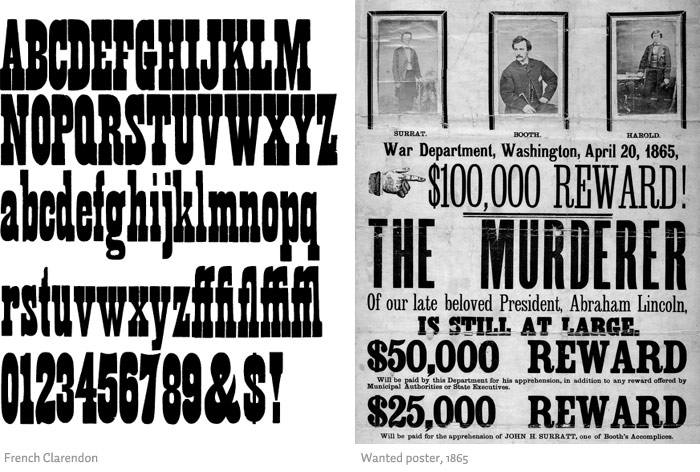
Picture found here.
It's History: "Clarendon is a slab-serif typeface, and is considered to be the first registered typeface with the original matrices and punches remaining at Stephenson Blake and later residing at the Type Museum, London. They were marketed by Stephenson Blake as Consort, though some additional weights (a bold and italics) were cut in the 1950s. It was named after the Clarendon Press in Oxford. There’s only moderate contrast between thick and thin strokes, common of slab-serifs. It was originally designed by Robert Besley [in England] for the [Thorowgood and Co. then known as] Fann Street Foundry in 1845. It was later copied heavily by other foundries. Due to its popularity, Besley registered the typeface under Britain's Ornamental Designs Act of 1842. The patent expired three years later, and other foundries were quick to copy it." (Source #1 and #2)

"It was polished by Edouard Hoffmann and Hermann Eidenbenz at Haas Foundry a little over a century later. Haas’ revival of this typeface in 1953 precipitated the revivals that follow." (Source #3)

Picture found here.
What Type of Font It Is: Slab Serif. Slab Serif typefaces developed from large-scale display letters used in both woodblock letterpress printing and architectural lettering. The robust forms and substantial serifs of the Clarendons and Egyptians were perfectly suited to casting as relief forms in metal, and as a result they feature in many Victorian engineering projects as well as appearing in posters, playbills, and other promotional materials of the time.

"At their best, Slab Serifs are both robust and colorful, with the serifs providing a strong continuity of line. The historic Slab Serifs are generally most effective in the heavier weights. Clarendons, in particular, are useful in text setting, particularly in cases where a greater weight is required than might be provided by more traditional text faces." (Source #4)
Picture found here.
How You Can Design With It: "Clarendon is among the most evocative and colorful of the Victorian faces. The lighter weights are a later development that extends the functionality of the face, being more suitable for text setting than the bold form that is the basis of the genre. [....] Clarendon will hold its legibility fairly well when used as a screen font in web applications or when printed onto low-quality paper. [....] It is also effective for architectural and environmental applications, because the strong serif forms can be easily cut out and reproduced in three-dimensional media." (Source #5)

"Clarendon has strong letterforms common to slab serifs. It’s also a very readable typeface, which makes it appropriate for use at somewhat smaller sizes. Strong letterforms make Clarendon a great choice for things like signs, logos, and headlines. It’s already used by companies like Sony and Wells Fargo in their logos." (Source #1)

"The font was used extensively by the government of the German Empire for proclamations during World War I, and was also common in wanted posters of the American Old West. Craw Clarendon Bold was used by the United States National Park Service on traffic signs, but has been replaced by NPS Rawlinson Roadway. In 2008, the typeface was utilized extensively by the Ruby Tuesday restaurant chain in the re-launch of their corporate identity. Via, the travel magazine of the American Automobile Association, uses the typeface for its logo and headline copy." (Source #2)

Picture found here.
Where You Can Get It: You can purchase it at these locations for varying prices: Adobe, LinoType, FontShop, and MyFonts.

Descriptive Terms for It: Display, large blocks of text, old, poster design, serif, Slab Serif, Victorian, and whole family.

Sources:
- #1 - http://www.webdesignerdepot.com/2011/08/the-most-popular-fonts-used-by-designers/
- #2 - http://en.wikipedia.org/wiki/Clarendon_(typeface)
- #3 - http://www.myfonts.com/fonts/bitstream/clarendon/
- #4 - The Complete Typographer: A Manual for Designing with Type" by Will Hill, 2nd Edition, p. 102
- #5 - The Complete Typographer: A Manual for Designing with Type" by Will Hill, 2nd Edition, p. 104

Examples:
Picture found here.
Picture found here.
Picture found here.
Picture found here.

Monday, December 10, 2012

Typeface Review: "Optima"

What It Looks Like:
Picture available here.

Its History: "Optima is a Humanist Sans Serif typeface designed by Hermann Zapf between 1952 and 1955 for the D. Stempel AG foundry [located in] Frankfurt, Germany." (Source below. #1) 

"At the Franciscan Basilica di Santa Croce in Florence on October 3rd, 1950, one visitor was looking at the 276 gravestones through quite different eyes than the other tourists. The great names of Michelangelo, Rossini, Galilei and Machiavelli held less fascination for him than the great variety of lettering carved in the stone. Because he had left his notebook behind at the hotel, Hermann Zapf sketched a few characters on a 1000 lire note." (Source below. #2)

"A delicate sans serif, characterized by its tapered stems, Optima alludes to Greek inscriptional forms without appearing archaic." (Source below. #3)

"Hermann Zapf, born November 8, 1918, is a German typeface designer who lives in Darmstadt, Germany. He is married to calligrapher and typeface designer Gudrun Zapf von Hesse.

"Zapf's work, which includes Palatino and Optima, has been widely copied, often against his will. The best known example may be Monotype's Book Antiqua, which shipped with Microsoft Office and was widely considered a "knockoff" of Palatino. In 1993, Zapf resigned from ATypI (Association Typographique Internationale) over what he viewed as its hypocritical attitude toward unauthorized copying by prominent ATypI members." (Source below. #4)
Picture available here.
What Type of Font It Is: Humanist Sans Serif - "Within the context of sans serif faces, the term 'Humanist' refers to faces based upon a classical or early Humanist model, in which the underlying proportions are derived from the Roman capital letter.

"Humanist Sans typefaces function well for the setting of extended text, though they do not as a rule provide for very economical setting because most have a lower x-height than the Grotesques. Heavier weights may be effectively used for smaller quantities of text, and benefit from generous leading.

"Humanist Sans faces are notable for their compatibility with classic serif types, and can be paired with a number of Humanist, Garalde, and Transitional faces that are based upon similar Roman proportions." (Source below. #5)

How You Can Design With It: "Optima is an elegant if conservative type choice, and is well-suited to understated designs. Most famously, it’s been used for the Vietnam Veterans Memorial, and by the 2008 John McCain presidential campaign. It’s also the official branding typeface of EstĆ©e Lauder Companies and Aston Martin." (Source below. #6)

Where You Can Get It: Available for a free download here: http://www.fontsupply.com/fonts/O/Optima.html. There are Optima alternatives available for free download here: http://www.fontspace.com/category/optima.

Descriptive Terms For It: book copy, classical, Humanist, large blocks of text, legibility, logo, modern, readable, and sans serif.

Sources: 
- #3 and #5: "The Complete Typographer: A Manual for Designing with Type" by Will Hill, 2nd Edition, p. 110 and 117

Examples:
Picture can be found here.